 Shark Sensei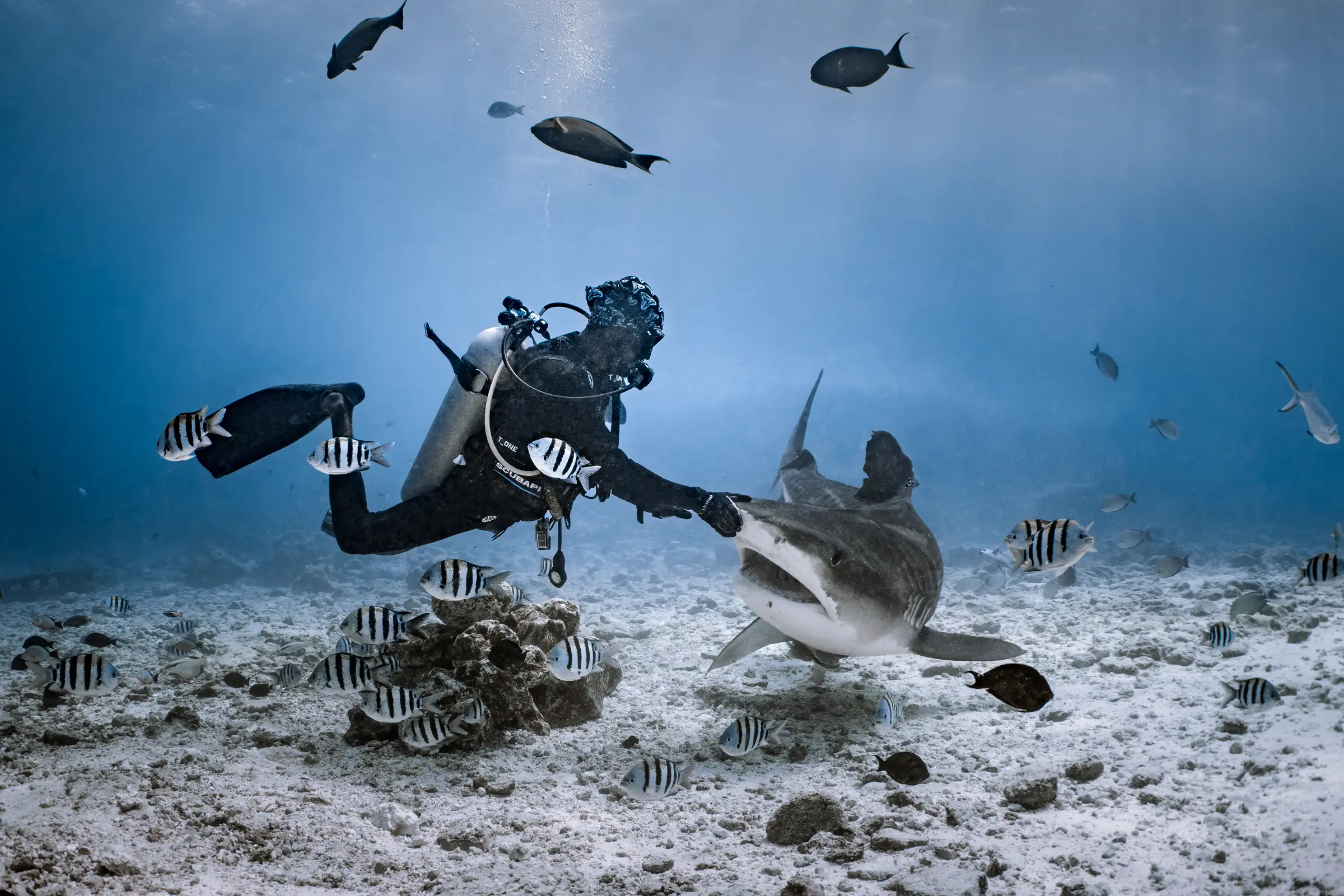
Training10 min read
Tiger Shark Diving in the Maldives: What the Site Asks of the Person Leading It
Fuvahmulah's tiger shark dive is shallow, warm and clear. That is exactly what makes it easy to underestimate — and why the person leading it needs more than dive experience.
- tiger sharks
- fuvahmulah
- safety diver
- shark behaviour
- dive leadership

Most writing about tiger shark diving in the Maldives is addressed to the diver who wants to go. This one is addressed to the person who will be responsible for them. Fuvahmulah has become one of the few places on earth where an encounter with tiger sharks is an ordinary part of the diving week rather than an expedition. That reliability has drawn divers, dive centres and a great deal of attention. It has also quietly raised a question the industry has been slow to answer: who is trained to lead these dives, and what were they trained to do? The site itself is where that answer has to start. So before anything about courses, here is the dive — and what each part of it asks of the professional in the water.
Where the sharks are, and why they are there
The site sits at the entrance to Fuvahmulah's harbour, on the island's east coast. It is a short ride out — a few minutes by dhoni, not a crossing. What makes it work is not the topography. It is a habit. Fuvahmulah is a fishing island, and for generations the catch has been cleaned at the harbour entrance. Offcuts have gone into the water at roughly the same place, at roughly the same time of day, for far longer than anyone has been diving there. Tiger sharks are opportunists with long memories and long lives — thirty to fifty years — and a population of them learned that schedule the way animals everywhere learn a reliable food source. The sharks were not attracted to Fuvahmulah by diving. Diving arrived at a pattern that already existed. Why this matters to someone leading the dive: an animal that is present because of a decades-old routine behaves differently from one drawn to a site it has no history with. It arrives with expectations. It has a history with the place, and often with other sharks there. A professional who understands why the animals are present can anticipate them. One who has only been told that "the sharks show up here" is reacting.
The conditions, and why they are the trap
On paper this is one of the gentlest shark dives anywhere.
- A sandy shelf averaging about eight metres, running between five and ten, at the lip of the harbour
- Visibility usually good, at its best in the dry months and noticeably down during the south-west monsoon
- Water between about 27 and 30°C in every month of the year — a 3mm suit is enough
- Mild current, with the shelf largely sheltered from the stronger water outside
- Deep water immediately adjacent — the shelf edge drops past thirty metres, so the sharks come and go without being channelled, and the dive stays on the shelf side of that edge
Kept on the shelf, the dive has no decompression pressure. No cold. No fighting the current. No struggling to see. That is precisely the problem. Every environmental factor that normally forces discipline on a dive has been removed here. Depth is not managing your bottom time. Cold is not ending the dive. Poor visibility is not keeping the group tight. Nothing external is imposing structure, which means all of the structure has to come from the person leading. A demanding site disciplines a weak leader. An easy one exposes them.
The one hazard the conditions do not remove
There is an exception to all of that, and it has nothing to do with sharks. Tiger Harbour is a harbour. It is the working entrance to a fishing island's port, and boats use it — that is the entire reason the sharks are there. Which means the ceiling above this dive is not empty water. It is traffic. So the single most consequential piece of the dive is the part that has no shark in it at all: the ascent, the safety stop, and the surface. A group that has spent half an hour with its attention downward and outward has to be brought up through a boat lane, held there, and surfaced in a controlled, compact shape — by someone who has been tracking what is happening above them the whole time. Add to that the surge that moves through a harbour entrance, and entries and exits that are not the calm giant-stride of a resort jetty, and the picture is clear enough: the animals are the safest-behaved element of this dive. The hazards are the boat, the water moving in the gap, and the thirty seconds when a whole group is on the surface in a channel. None of that shows up in a photograph, which is why it is absent from almost everything written about this site. It is, however, most of what the person leading is actually responsible for.
What a tiger shark actually does
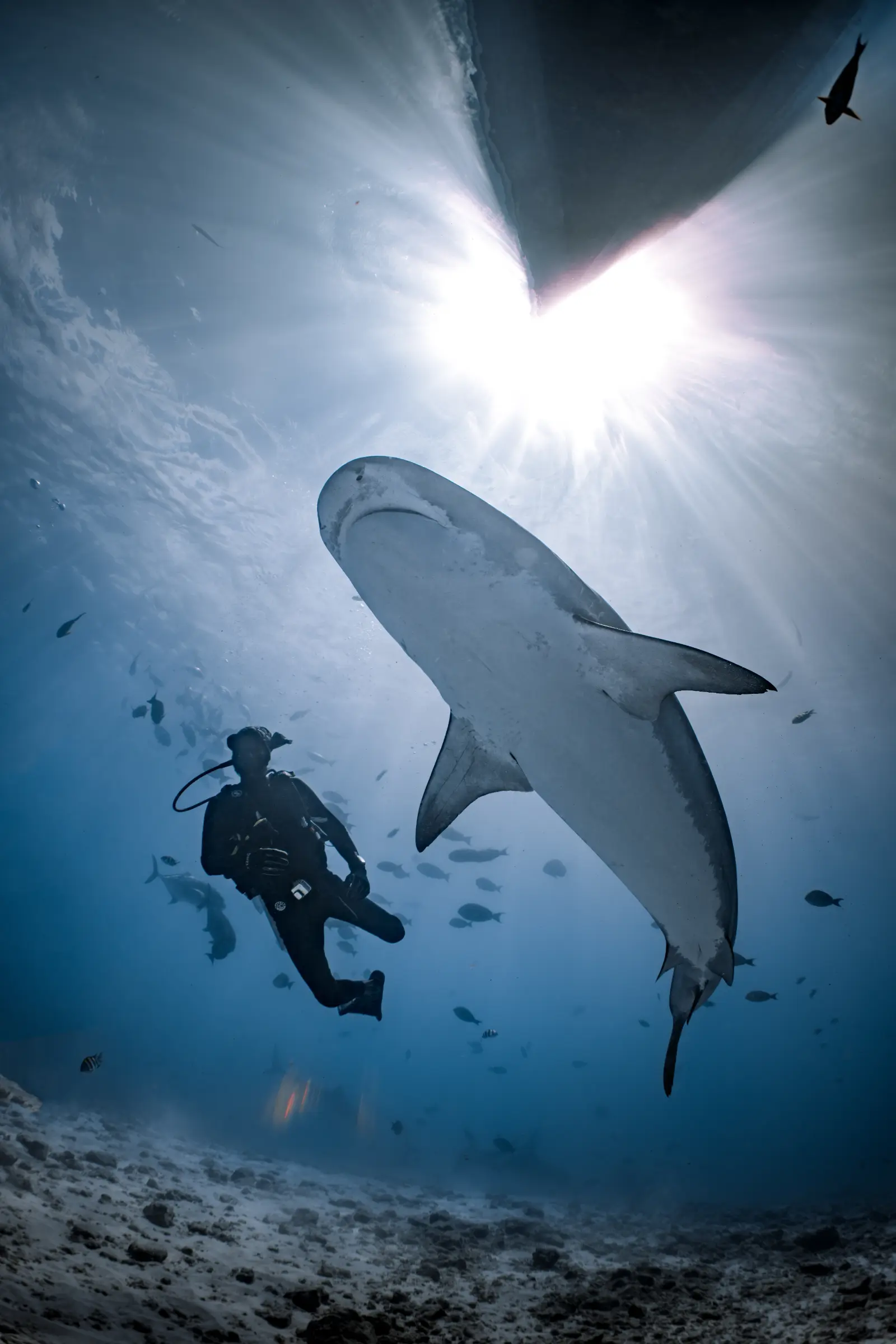
Reputation is the least useful thing anyone brings to this dive. Galeocerdo cuvier is a large animal — adults commonly run three to four and a half metres, with the biggest individuals larger still, and several hundred kilograms with it. It is also, in the water, usually unhurried. Tiger sharks tend to investigate rather than charge. They approach on a slow, wide arc, assess, and decide. The dramatic footage that circulates online is not representative of a normal dive; it is representative of what a camera chose to keep. Two things about their behaviour matter more than their size. They are individuals. Some approach confidently and come close. Others hold off and never commit. The same animal is not identical on two different days. A professional who has learned "how tiger sharks behave" as a single description has learned something that will be wrong in front of them regularly. They sort themselves out. Larger animals — often mature females — take and hold the better positions on the shelf. That means the shark nearest your divers may be the one being displaced, and displacement changes behaviour. A safety diver watching only the closest animal is watching the wrong half of the situation.
Reading the animal, not the checklist
Every operation has rules. Rules are necessary and they are not sufficient, because rules describe the normal case and the normal case is not what hurts people. What a professional in this environment is actually doing is continuous assessment:
- Baseline. What does this animal's ordinary movement look like today? You cannot notice a change from a baseline you never established.
- Change. Tightening turns. A shortening approach arc. A shift from cruising to a more directed posture. Pectoral fins dropping. Increasing pace.
- Attention. What is the animal looking at? A shark orienting on a diver is a different situation from one orienting on the seabed.
- Count and spread. How many animals are in the area, and where are the ones you are not currently looking at?
- Decision. What will you do, and at what point? A threshold decided in advance is a plan. A threshold decided during the event is a reaction.
This is teachable. That is the entire point. It is often treated as intuition that accrues over years alongside an experienced guide, and experience genuinely does build it — but intuition that has never been made explicit cannot be assessed, cannot be handed on reliably, and cannot be held to a standard.
The divers are the harder problem
Here is the part that surprises people who come to this work from general dive guiding. The shark is usually the more predictable element. Recreational divers on a tiger shark dive arrive with adrenaline, a camera, and a strong desire to get closer than they were told to. They drift. They rise off the bottom without noticing. They turn their backs to the water to frame a shot. They become separated from the group by a metre at a time. Under a group of large predators, a diver who is slowly ascending and facing the wrong way is the real developing risk on the dive — not the animal being photographed. So the leader's work is mostly diver management:
- Positioning the group before the animals arrive, not after
- Keeping it compact and low, with the sand at their backs
- Holding people stationary, because movement toward an animal changes that animal's behaviour
- Watching the diver who has stopped watching themselves
- Deciding when the dive is finished, and saying so
And knowing what happens when it goes wrong — because a professional's competence is measured on the day nothing goes to plan, not on the hundred days it did.
What responsible use of bait has to mean in practice
The ethics of this dive are also its safety procedure, which is why they are not a separate conversation. An operation that changes an animal's behaviour for a photograph has made the dive less predictable for every person in the water and for everyone diving the site afterwards. Hand-feeding teaches association with divers. Chasing teaches avoidance or defence. Touching removes the distance that keeps everyone safe. Crowding an animal removes its exit, and an animal without an exit is the one situation you never want to create. There is also a long-term argument, and it is not sentimental. Tiger sharks are listed as Near Threatened, with a declining global population. Fuvahmulah's population is an asset that belongs to the island. A professional trained here is not only responsible for today's group. They are responsible for whether the site still behaves like this in ten years. Behaving well and diving safely are, here, the same skill.
What you need before you come
Honestly stated, because vague prerequisites help nobody:
- Certification. The Tiger Harbour dive sits on a shallow, sheltered shelf between five and ten metres, and an Open Water certification is enough for it. Be aware that it is the only site on Fuvahmulah that is. Every other site — the thresher cleaning stations, the southern points where hammerheads school, the walls that fall into open ocean — is dived to thirty metres, which is an Advanced Open Water Diver's depth, not an Open Water Diver's eighteen. Arriving with Open Water means arriving for one dive site.
- Currency. Recent diving matters more than a large logbook. Buoyancy you have to think about is buoyancy you cannot spare attention for.
- Exposure. A 3mm suit covers the whole year.
- Time. Most divers get far more out of several days than out of one. The dive is not the same twice: different animals, different behaviour, different light.
And if you are coming to work rather than to watch — if you intend to be the person the group is following — then dive experience is the entry requirement, not the qualification.
Where training fits
Guiding divers and leading divers around large sharks are not the same job, and for a long time there was no formal route from one to the other. You learned by standing next to someone who already knew, and what you learned was that person's version of it. That is what the training here exists to change. The SSI Tiger Shark Eco Diver course is for the diver who wants to understand what they are looking at — the animals, the site, the behaviour, and how to conduct themselves in the water so the encounter stays what it should be. The SSI Tiger Shark Safety Diver course is for the professional who will be responsible for other people in that environment. Behaviour, risk assessment, positioning, group management, intervention, and being answerable for the divers around you. The theory is studied before you travel; the assessment happens in the water, in Fuvahmulah, against a written performance standard. The site will be there either way. The question this island's growth keeps asking is who is in the water with the divers, and what they were trained to do when the ordinary dive stops being ordinary.
Ready to meet them in the water?
The theory is studied online and the diving happens in Fuvahmulah. Ask about a course and the school will reply about suitability and dates.